
Disclosure: Gadgets Finds is an Amazon Associate. We may earn from qualifying purchases if you buy through links on this page, at no extra cost to you. Prices and availability change on Amazon.
Buying Guide
Best Portable Chargers for Travel in 2026
Last updated: November 2026
A travel power bank has one job: put a real charge back into a phone, and sometimes a laptop, somewhere between the security line and the hotel. The useful ones in 2026 are USB-C, they tell you how much charge is left, and they stay under the 100 watt-hour line that airlines use for spare lithium batteries.
This guide stays on four new Anker listings. Each title links to that product, and each review ends with its own View on Amazon button. None of them is renewed or refurbished. Capacity claims from no-name banks are ignored on purpose. A printed 50,000mAh on a pack the size of a deck of cards is a reason to walk away, not a bargain.
What to check before you fly
Milliamp-hours are a marketing number. Airlines use watt-hours. Watt-hours are mAh times the pack’s nominal voltage, divided by 1,000. A phone-sized 10,000mAh bank is usually around 36–38 Wh. A 20,000mAh bank is usually in the low 70s. The number that matters is the one printed on the battery, not the one in the title.
- In the United States, spare lithium-ion batteries and power banks go in carry-on baggage. They do not go in checked bags.
- Under 100 Wh, you do not need special airline approval. That covers a normal 10,000mAh or 20,000mAh bank.
- From 101 Wh to 160 Wh, most airlines allow the pack only with their approval, and they often cap you at two.
- Over 160 Wh is not allowed on a passenger flight. A “30,000mAh” bank with no printed Wh rating is how people get stopped at the gate.
- Some airlines are stricter than the FAA floor, and some ask you to keep the terminals covered. Read the carrier’s page for that ticket.
1. Anker 20,000mAh 87W
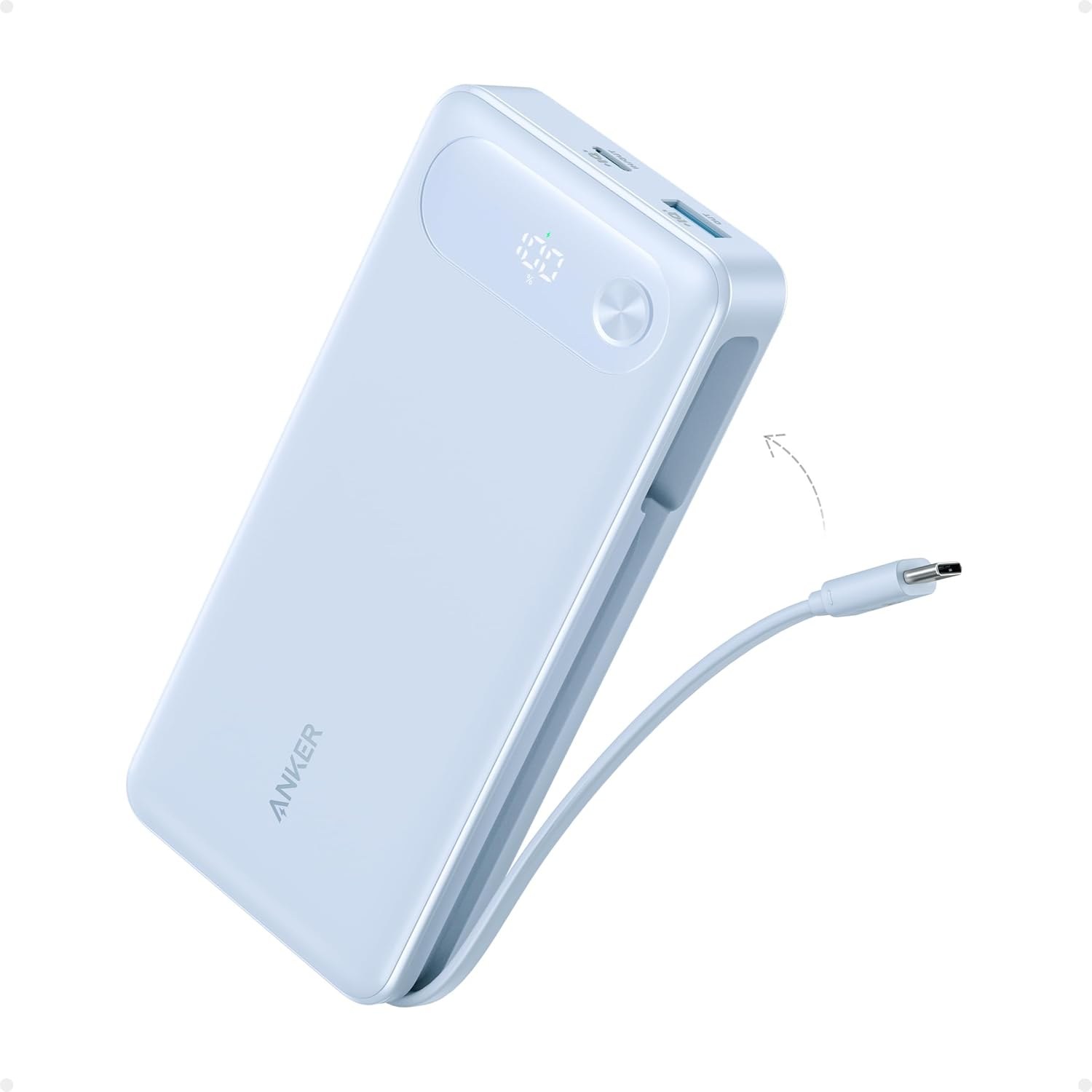
Anker 20,000mAh Power Bank (87W)
- Listing: Model A1383, built-in USB-C cable, sold new
- Capacity: 20,000mAh
- Output: 87W shared across three ports, up to 65W on one device
- Size: 6.2 × 2.9 × 1.0 in, 15.5 oz
This is the bank to buy if you want one pack for a trip and you do not want to think about it again. Anker’s listing is the 20,000mAh model A1383 with a built-in USB-C cable and three ports. The shared output is 87W. One device can take up to 65W, which is enough to move a 14-inch laptop rather than only a phone. Anker says the built-in cable can take an iPhone 15 Pro to about 58 percent, or a MacBook Air to about 52 percent, in 30 minutes, and that a 65W wall charger refills the bank itself in about an hour and a half.
The body is 6.2 × 2.9 × 1.0 inches and 15.5 ounces. That is a jacket-pocket brick, not a card. The cable stores on the pack, so you are not fishing a loose USB-C lead out of a backpack every time a phone dies at the gate. Anker rates that cable for more than 10,000 bends. There is a percentage display, so you can see whether the bank is at 80 percent or 15 before you leave the hotel. The warranty on this model is 18 months.
Anker’s own listing calls the pack approved for airline travel. A 20,000mAh lithium-ion bank in this class is normally labeled in the low 70s of watt-hours, well under the 100Wh carry-on line. Still read the watt-hour figure printed on the unit you receive. Do not assume a different 20,000mAh model, or a bundle that adds a second bank, has the same label. Colors vary on the listing. The link is this 87W built-in-cable model, not the older 15W PowerCore 20K and not a two-pack.
Strengths
Enough capacity for several phone charges, 65W for a laptop, a cable that stays attached, and a size that still fits a personal item.
Limitations
15.5 ounces is a lot if you only carry a phone. It will not run a 16-inch laptop at full speed the way the Prime will.
Verdict: The default travel bank. Best suited for a phone plus a tablet or a light laptop on a flight.
View on Amazon2. Anker Nano 10,000mAh 30W
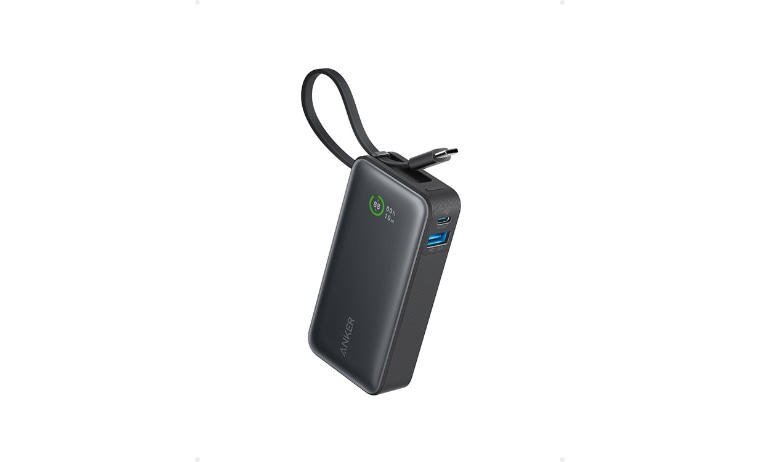
Anker Nano Power Bank (10,000mAh, 30W)
- Listing: 10,000mAh, built-in USB-C cable, sold new
- Energy: 36Wh, from two 5,000mAh cells at 7.2 V
- Output: 30W on the USB-C cable, up to 22.5W on USB-A
- Size: 4.09 × 2.06 × 1.02 in, 7.58 oz
The Nano is the bank that disappears in a bag. Anker lists it at 4.09 × 2.06 × 1.02 inches and 7.58 ounces, with a built-in USB-C cable about 0.6 feet long, plus a USB-C port and a USB-A port. The cable does 30W in both directions. Anker says the bank can reach 50 percent in about 45 minutes and a full charge in about an hour and a half on a 30W charger, and that an iPhone 14 can hit about 50 percent in 30 minutes from the bank. The energy rating published for this model is 36Wh, so the airline question does not come up.
Thirty watts is the right ceiling for a phone and a small tablet. It is not a laptop charger in any useful sense. A MacBook will sip from it and the percentage will fall fast. Ten thousand milliamp-hours is roughly one and a half to two phone charges once you account for conversion loss, not the “three full charges” some listings imply. The little screen shows remaining time, which is more useful than four dumb LEDs. Anker’s warranty on this Nano is 24 months, and the shell uses about 80 percent post-consumer recycled plastic.
Buy this when the trip is a weekend, or when the 20,000mAh brick feels like too much weight for a day around a city. The link is the 30W built-in-cable Nano, not the 45W retractable-cable version and not the 3-in-1 with the wall prongs. Those are different products with different prices.
Strengths
Light, 30W is enough for a phone, the cable is attached, and 36Wh is an easy carry-on.
Limitations
One long day with a phone and a tablet will empty it. It will not keep a laptop working through a flight.
Verdict: The pocket pick. Best suited for a phone on a short trip.
View on Amazon3. Anker Prime 27,650mAh
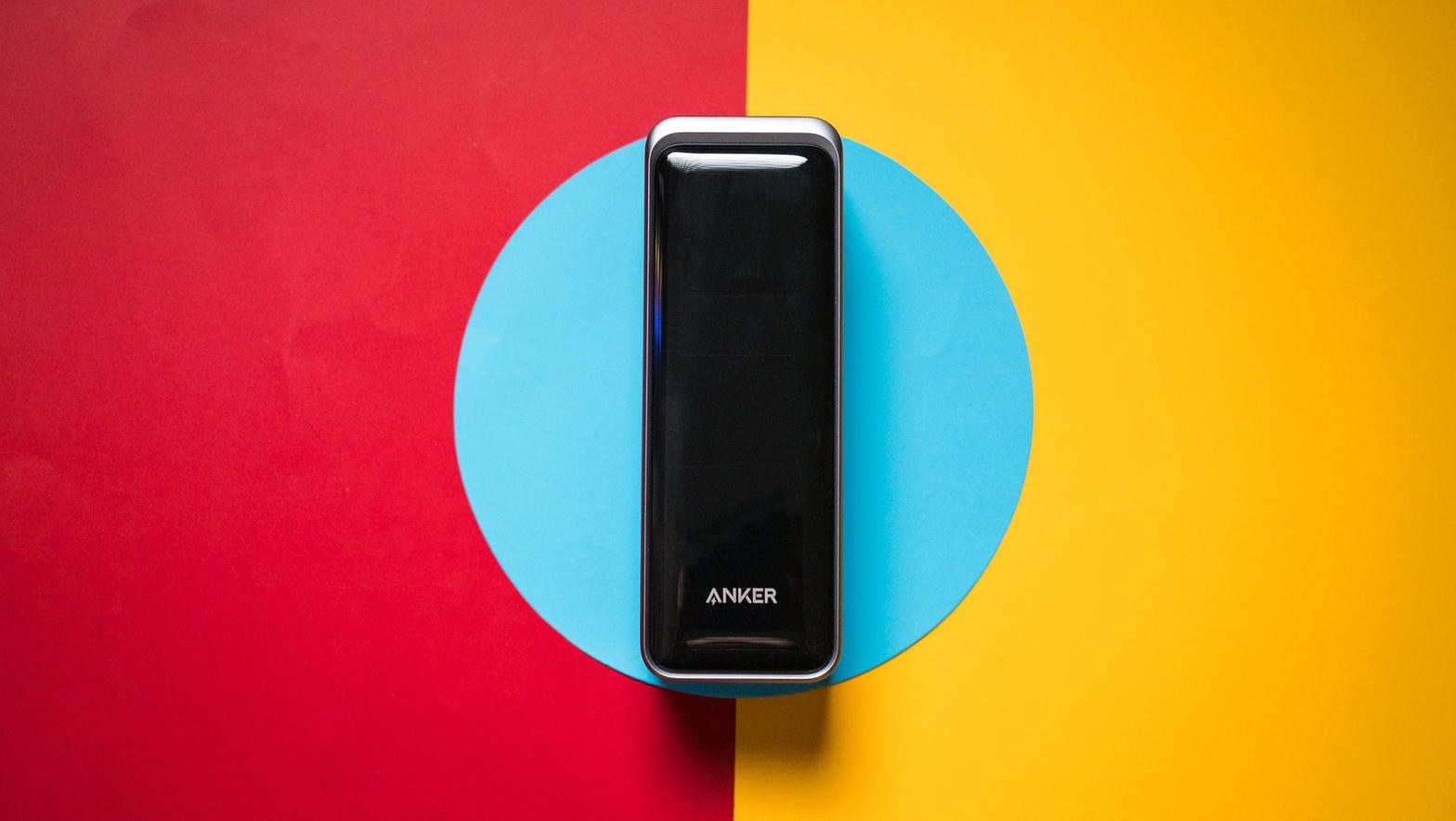
Anker Prime 27,650mAh (250W)
- Listing: Power bank only, charging base not included, sold new
- Capacity: 27,650mAh, labeled 99.54Wh
- Output: 250W total, up to 140W on one USB-C port
- Recharge: Anker quotes about 37 minutes at 170W using two chargers
The Prime is the bank you buy when the thing that dies is a laptop, not a phone. Anker rates it at 27,650mAh and, more importantly, 99.54 watt-hours. That figure is printed so the pack sits just under the 100Wh line. The listing says it meets TSA rules for carry-on. It does not meet the rules for a checked bag. Because it is so close to the limit, keep the watt-hour label easy to show. A gate agent who only sees “27,650mAh” may ask.
Output is the other reason it costs what it costs. Three ports share up to 250W, and one USB-C port can do 140W. Anker says that is enough to take a 16-inch MacBook Pro to about 50 percent in 28 minutes, and that the same pack can charge a 13-inch MacBook Air (M2) about 1.28 times or an iPhone 14 about 4.67 times. Those are Anker’s numbers for those specific machines, not a promise for every laptop. A 140W laptop will still pull the bank down in a couple of hours of real work. You are buying a flight’s worth of laptop power, not a weekend off the grid.
Recharging is fast only if you bring a serious charger. Anker quotes about 37 minutes from empty at 170W across two USB-C inputs. A 30W phone brick will make this feel slow. The linked style is the power bank by itself. The charging base is a separate, more expensive bundle, and this card does not include it. There is an Anker app for status and finding the pack. The warranty listed with the bank is 24 months, and the box includes a short USB-C cable and a pouch.
This is not the bank most travelers need. If your heaviest device is a phone, the 20,000mAh model above does the job with less weight. Buy the Prime when you already travel with a USB-C laptop and you are tired of hunting seat power.
Strengths
140W on one port, 99.54Wh so it can fly in a carry-on, and enough energy for a laptop plus a phone.
Limitations
Heavy, expensive, and close enough to 100Wh that you should be ready to show the label. The base is not in this listing.
Verdict: The laptop bank. Skip it if you only charge phones.
View on Amazon4. Anker Nano 3-in-1
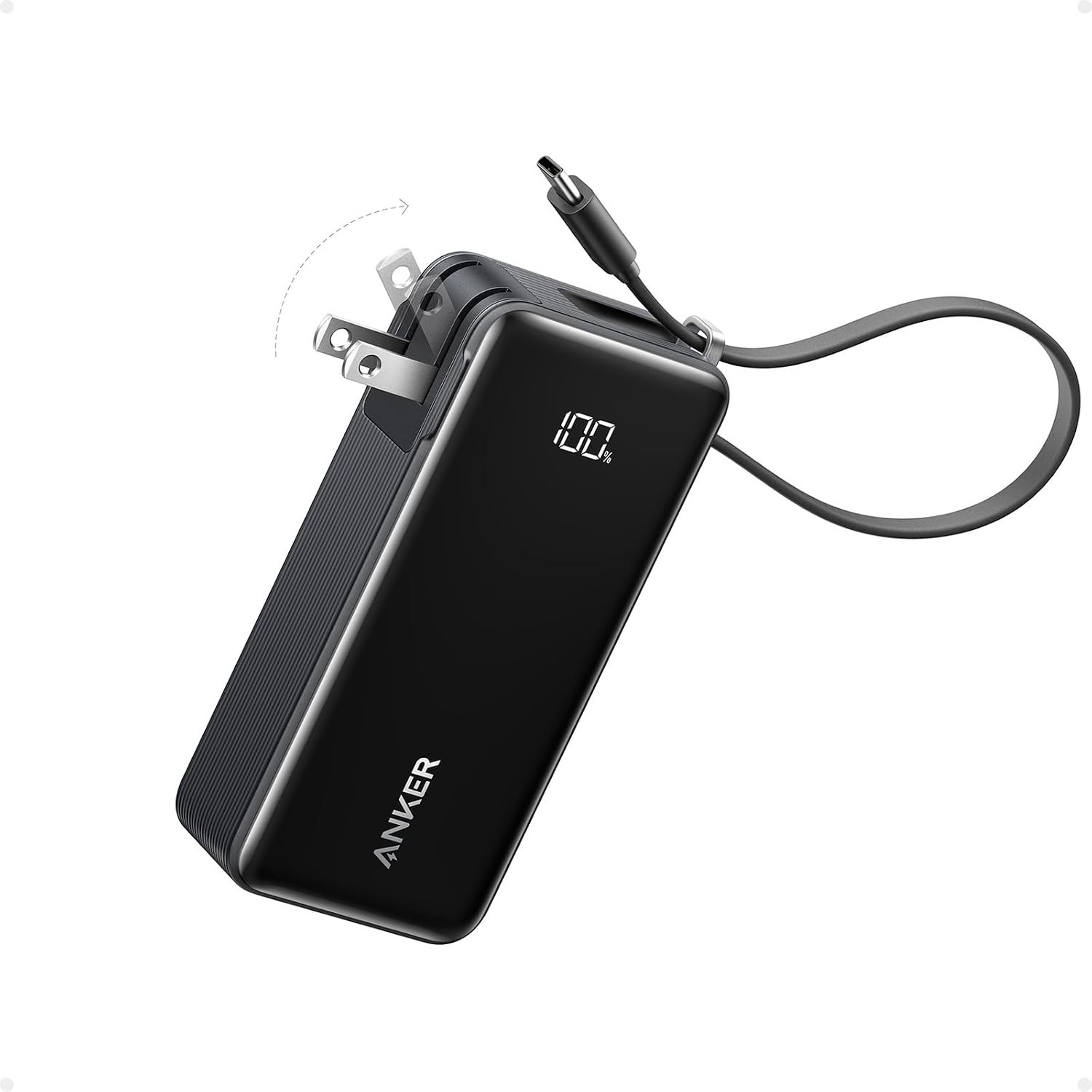
Anker Nano 3-in-1 (10,000mAh, 30W)
- Listing: Model A1637, USB-C cable, black, sold new
- What is built in: 10,000mAh battery, foldable wall prongs, USB-C cable
- Output: 30W, plugged in or from the battery
- Size: 4.25 × 2.01 × 1.22 in, about 8.82 oz
The 3-in-1 is the Nano with a wall plug folded into the body. Model A1637 is a 10,000mAh, 30W pack, a built-in USB-C cable, and US-style prongs. Anker lists it at 4.25 × 2.01 × 1.22 inches and about 8.82 ounces. In a hotel you plug it straight into the outlet and charge the phone, or you charge the bank. On the move the prongs fold away and it behaves like a normal power bank. Anker’s claim for this model is an iPhone 15 Pro from empty to about 50 percent in 25 minutes.
That is the convenience. You can leave the separate wall charger at home. The cost is the prongs. They are a North American plug. In Europe or the UK you still need a passive adapter for the pins, or you ignore the prongs and recharge the bank from any USB-C charger. Do not buy the Lightning-cable version of this 3-in-1 if your phone is an iPhone 15 or newer. That older style is a different listing, and Anker marks it as not for the 15 and 16 series. This card is the USB-C model.
Capacity is the same class as the plain Nano, so the same limit applies. It is a phone bank with a plug, not a second laptop battery. It is a little thicker and a little heavier than the cable-only Nano because the prongs have to live somewhere. The warranty on the A1637 is 18 months. The choice is whether you want the plug more than you want the smaller body. Confirm the live price on Amazon.
Strengths
One object replaces a bank, a short cable, and a 30W wall charger. Fine for a US hotel and a day out.
Limitations
US prongs only. 10,000mAh still runs out on a long day. Slightly bulkier than the plain Nano.
Verdict: The one-item kit for trips inside the US. Best suited for people who hate packing a charger and a cable.
View on AmazonQuick comparison
| Bank | Capacity | Top output | Carry-on |
|---|---|---|---|
| 20,000mAh 87W | 20,000mAh | 65W | Yes, check the label |
| Nano 30W | 10,000mAh / 36Wh | 30W | Yes |
| Prime | 27,650mAh / 99.54Wh | 140W | Yes, show the label |
| Nano 3-in-1 | 10,000mAh | 30W | Yes |
How to choose
- One bank for most trips, phone and maybe a laptop: the 20,000mAh 87W.
- A weekend and a light bag: the Nano 10,000mAh.
- A USB-C laptop is the device you actually care about: the Prime, and keep the 99.54Wh label visible.
- You want to stop packing a wall charger on US trips: the Nano 3-in-1. Take a plug adapter if you leave the country.
- Do not charge the bank from an airplane seat outlet unless that airline says you can. Carry it on. Do not check it.
Final verdict
Buy the Anker 20,000mAh 87W with the built-in cable. It is the size and the wattage that match a normal trip, and Anker already calls that listing fit for airline travel as long as you confirm the watt-hours on the label. Drop to the Nano when ounces matter. Step up to the Prime only when a laptop has to survive the flight. The price on Amazon is the one that matters. Use the 3-in-1 when the goal is to pack one object instead of three, and only if a US plug is what you need.
Prices move. Open the button under the review and check the watt-hour marking, the cable type, and whether a charging base is actually in the box before you pay.
Questions people ask before buying
What is the best portable charger for travel?
The Anker 20,000mAh 87W with the built-in USB-C cable. It covers a phone and can help a laptop, and it is the default for a normal trip.
Can I take these power banks on a plane?
Spare lithium batteries go in carry-on, not checked bags. Confirm the watt-hour label. The Prime is 99.54Wh, just under the usual 100Wh airline limit.
Which bank should I skip?
No-name packs that claim 50,000mAh in a tiny case. The printed number is not a real capacity.
Power banks belong in carry-on baggage. Read the watt-hour rating on the pack and your airline’s rule before you fly.